
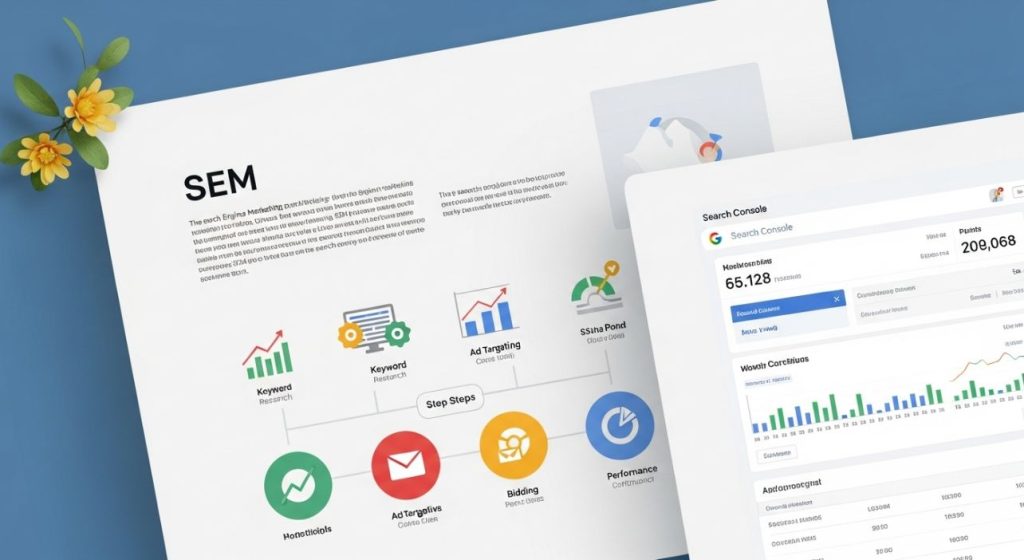
SEM: The Ultimate Guide
Driving Growth with Paid Search Marketing
Beyond the Acronym: Demystifying SEM
A simple search for the acronym “SEM” can plunge a user into a world of unexpected ambiguity. Results may point to the highly technical domain of the Scanning Electron Microscope, a powerful tool for scientific analysis. Others might reference the Stock Exchange of Mauritius, structural equation modeling in statistics, or a myriad of other unrelated organizations and concepts. This initial confusion highlights a crucial point for any business looking to navigate the digital landscape: in the world of online marketing, clarity is paramount.
For the purposes of this guide and within the context of digital marketing, SEM stands for Search Engine Marketing. It is a form of internet marketing that involves the promotion of websites by increasing their visibility in search engine results pages (SERPs) primarily through paid advertising. This is most commonly known as pay-per-click (PPC) advertising, a system where businesses pay a fee each time one of their ads is clicked.
The definition of SEM has itself been a source of confusion, reflecting the maturation of the digital marketing industry. Initially, the term was popularized in 2001 as a broad umbrella covering all activities designed to improve search engine visibility, including both paid advertising and Search Engine Optimization (SEO). However, as the industry evolved, SEO and PPC grew into highly distinct specializations, each demanding unique strategies, tools, and expertise. SEO became a long-term discipline focused on earning organic rankings through content and technical excellence, while PPC became a fast-paced, data-driven advertising channel. Over time, the paid search community largely adopted the “SEM” label, and today, the term is used almost exclusively to refer to paid search activities.
This guide serves as a definitive roadmap for businesses in the United States seeking to harness the power of SEM. It moves beyond simple definitions to explore the strategic “how” and “why,” providing a comprehensive framework for driving immediate, measurable, and sustainable growth through paid search.
The Two Sides of Search: SEM and SEO
In the quest for online visibility, businesses encounter two primary channels: Search Engine Marketing (SEM) and Search Engine Optimization (SEO). They are not adversaries but rather two powerful, complementary pillars of a holistic search strategy. Understanding their fundamental differences in cost, speed, and sustainability is the first step toward building an effective digital marketing plan and allocating resources intelligently.
Core Differentiators: A Detailed Breakdown
The choice between focusing on SEM or SEO—or, ideally, leveraging both—depends entirely on a business’s specific goals, timeline, and budget.
Pace & Immediacy
The most striking difference is speed. SEM offers near-instantaneous results. A well-configured paid campaign can place a business’s ads at the top of the SERP within hours of launch, making it an incredibly powerful tool for new product launches, promotions, or any situation requiring immediate visibility. Conversely, SEO is a long-term endeavor. Achieving high organic rankings for competitive keywords is a marathon, not a sprint, often taking months or even years of consistent effort in content creation, link building, and technical optimization.
Cost & Investment
SEM operates on a direct cost model, most commonly pay-per-click (PPC), where an advertiser pays a fee every time a user clicks their ad. This traffic is essentially rented; when the ad budget is paused, the visibility and traffic stop immediately. SEO traffic, on the other hand, is often called “free,” but this is a misnomer. While there is no charge per click, achieving and maintaining organic rankings requires a significant investment in resources, including expert time, high-quality content production, sophisticated software tools, and technical website maintenance.
Placement & Control
SEM provides prominent ad placements at the very top and bottom of the SERPs, areas that are explicitly marked with labels like “Sponsored” or “Ad”. This channel offers an unparalleled level of direct control. Advertisers can dictate the exact ad copy, target specific demographics and locations, choose precise keywords, and direct users to custom-built landing pages. SEO rankings are “earned” based on a search engine’s algorithm, which considers hundreds of factors. This means placement is less predictable and subject to algorithm updates, offering far less direct control over messaging and positioning.
Sustainability & Longevity
SEO is the practice of building a long-term digital asset. A web page that earns a top organic ranking can continue to generate valuable traffic for years with minimal ongoing maintenance, providing a sustainable and compounding return on the initial investment. The benefits of SEM are more transient. Its powerful visibility lasts only as long as the campaign is funded. It is a tap that can be turned on for immediate flow but provides no residual value once turned off.
To help clarify these distinctions, the following table provides a strategic overview for decision-making.
| Feature | SEM (Paid Search) | SEO (Organic Search) | Best For… |
|---|---|---|---|
| Speed to Results | Immediate (Hours to Days) | Slow (Months to Years) | Quick product launches, promotions, testing market demand, immediate lead generation. |
| Cost Model | Pay-Per-Click (PPC) | Indirect (Content, Labor, Tools) | Businesses with a dedicated advertising budget that need predictable traffic flow. |
| Longevity of Results | Temporary (Stops when you stop paying) | Long-Term & Sustainable | Building a durable brand presence, creating a long-term asset, content marketing. |
| Control over Targeting | High (Keywords, Demographics, Location, Time) | Low (Targeting is via content relevance) | Highly targeted campaigns, reaching specific customer segments, local advertising. |
| ROI Measurement | Direct & Immediate (ROAS, CPA) | Indirect & Delayed (Organic Traffic Value) | Businesses needing to prove direct, short-term ROI on marketing spend. |
The Power of Synergy: How SEM and SEO Create a Growth Flywheel
Viewing SEM and SEO as an “either/or” proposition is a strategic error. When integrated, they create a symbiotic relationship—a powerful financial and informational feedback loop where each discipline makes the other more efficient and profitable. This synergy is not just a theoretical concept; it has tangible impacts on a company’s bottom line.
This dynamic works in two primary directions. First, paid search campaigns act as a rapid intelligence-gathering tool for a long-term organic strategy. Imagine a business wants to rank for a high-value, competitive keyword. A full-scale SEO effort could take over a year and cost thousands of dollars in content and promotion, with no guarantee of success. Alternatively, the business can run a small, targeted SEM campaign for a fraction of the cost. Within days, this campaign provides invaluable real-world data: Which keywords have the highest commercial intent? Which ad copy variations generate the most clicks? Which value propositions resonate most with the target audience?. This data, acquired quickly and affordably, provides a proven blueprint for crafting a highly optimized piece of SEO content that is far more likely to rank well and convert, dramatically de-risking the larger SEO investment.
Second, a strong SEO foundation directly reduces the cost and increases the effectiveness of SEM campaigns. The core of Google’s ad auction is the Ad Rank formula, which is calculated by multiplying an advertiser’s maximum bid by their Quality Score. A higher Ad Rank leads to better ad positions. Quality Score is Google’s rating of the quality and relevance of your ads, keywords, and, critically, your landing pages. This is where SEO pays direct dividends to SEM. Core SEO practices—such as ensuring fast page load speeds, creating a mobile-friendly experience, and publishing high-quality, relevant content—are precisely what Google looks for in a positive landing page experience. By improving this component of the Quality Score, a business can achieve the same or even better ad positions for a lower cost-per-click (CPC). This creates a powerful flywheel: strong SEO lowers SEM costs, and the data from lower-cost SEM campaigns informs a smarter SEO strategy. A consultant who understands this interplay can deliver value far beyond managing isolated channels.
The Engine Room: Deconstructing the SEM Campaign
To move from strategy to execution, it is essential to understand the mechanics of a paid search campaign. Far from a “black box,” a successful SEM program is a well-architected system with distinct, interconnected components. Mastering how these parts work together is the key to launching and managing profitable campaigns.
The Ad Auction Unveiled
Every time a user enters a query on a search engine like Google, an automated ad auction takes place in milliseconds to determine which ads will appear and in what order. Winning this auction and securing a top ad spot is not simply a matter of having the deepest pockets. The system is designed to reward relevance to ensure a good user experience.
The outcome of the auction is determined by Ad Rank, a score calculated for each advertiser. The formula is fundamentally:
AdRank = MaximumBid × QualityScore
- Maximum Bid (Max CPC): This is the highest amount an advertiser is willing to pay for a single click on their ad.
- Quality Score: This is Google’s rating, on a scale of 1 to 10, of the overall quality of an ad. It is the great equalizer in the auction, allowing advertisers with highly relevant ads to pay less for better positions.
Quality Score itself is composed of three primary components:
- Expected Click-Through Rate (CTR): Google’s prediction of how likely a user is to click on an ad when it’s shown for a particular keyword.
- Ad Relevance: How closely an ad’s message matches the intent behind a user’s search query.
- Landing Page Experience: How relevant, transparent, and easy-to-navigate the landing page is for the user. This includes factors like page load speed and mobile-friendliness, directly linking SEM success to good web development and SEO practices.
This system means that a business with a highly relevant ad and a great landing page (resulting in a high Quality Score) can achieve a better ad position than a competitor with a larger budget but a lower Quality Score.
The Blueprint for Success: Architecting Your Account
A well-structured ad account is the foundation of any successful SEM effort. It allows for better management, more precise targeting, and higher Quality Scores. The standard hierarchy in a platform like Google Ads is logical and scalable:
- Account: The top-level entity, linked to a unique email, password, and billing information.
- Campaign: Campaigns are the next level down and are typically organized around a specific business goal, product category, service line, or geographic region. The overall budget, location targeting, and bidding strategy are set at the campaign level.
- Ad Group: Within each campaign are one or more ad groups. An ad group contains a set of closely related keywords and the ads that are specifically written for that keyword theme. The principle of tight theming is critical here; grouping similar keywords together ensures that the ads shown are highly relevant to the user’s search, which is a key driver of Quality Score.
- Keywords & Ads: This is the core of the operation. Keywords are the specific words or phrases an advertiser bids on to trigger their ads. The ads are the actual copy and creative that users see in the SERP.
- Landing Page: The final destination. This is the webpage a user is sent to after clicking an ad.
Keyword Strategy Mastery
Keywords are the bedrock of SEM, but a sophisticated strategy goes beyond simply choosing words related to a business. It involves a deep understanding of user intent and precise control over which searches trigger an ad.
Targeting User Intent
At its core, keyword research is the process of deciphering what a user is trying to accomplish. User intent can generally be categorized into three types:
- Informational Intent: The user is looking for information (e.g., “how does a car engine work”). These queries are often best targeted with SEO content like blog posts, as the user is not yet ready to buy.
- Commercial/Investigational Intent: The user is researching and comparing products or services (e.g., “best suv for families,” “semrush vs ahrefs”). These are prime targets for SEM, as the user is in the consideration phase of the buyer’s journey.
- Transactional Intent: The user is ready to take a specific action, such as making a purchase or contacting a business (e.g., “buy nike air max 90,” “plumber near me”). These high-intent keywords are the most valuable for SEM campaigns as they are closest to the point of conversion.
Keyword Match Types
To control ad spend and improve relevance, advertisers use match types to tell the ad platform how broadly or narrowly to match keywords to user search queries. The main types are:
- Broad Match: Allows an ad to show for searches that are related to the keyword, including synonyms and variations. It offers the widest reach but the least control and can lead to irrelevant clicks if not managed carefully.
- Phrase Match: An ad will show for searches that include the meaning of the keyword. For example, the phrase match keyword “tennis shoes” could show for searches like “buy tennis shoes online” or “red shoes for tennis.” This offers a balance of reach and control.
- Exact Match: An ad will only show for searches that have the same meaning or intent as the keyword. For instance, the exact match keyword [men’s running shoes] could show for “running shoes for men” but not for “men’s tennis shoes.” This provides the most control and typically the highest relevance.
The Unsung Hero: Negative Keywords
A hallmark of a professionally managed SEM campaign is the strategic use of negative keywords. These are terms that are explicitly excluded, preventing an ad from showing for irrelevant searches. For example, a company selling high-end accounting software would add negative keywords like “free,” “jobs,” “training,” and “internship” to avoid wasting its budget on users with the wrong intent.
The Art of the Bid: Mastering Bidding Strategies
Choosing the right bidding strategy is one of the most critical decisions in managing an SEM campaign. It is the primary lever for controlling ad spend, optimizing for specific business goals, and ultimately determining the profitability of the entire effort. The evolution of ad platforms has shifted this task from a purely manual exercise to a strategic partnership with sophisticated artificial intelligence.
The Control Paradox: Manual vs. Automated Bidding
The fundamental choice in bidding is between manual control and automated systems. This choice represents a strategic trade-off.
- Manual CPC (Cost-Per-Click) Bidding: This is the most traditional approach, where the advertiser manually sets a maximum bid for each individual keyword or ad group. It offers the highest degree of granular control, allowing an expert to fine-tune bids based on their own analysis. However, in large, complex accounts, this approach is incredibly time-consuming and simply cannot compete with the real-time processing power of machine learning. It is best suited for very small campaigns, for gathering initial performance data, or for advertisers who need absolute control over every click cost.
- Automated & Smart Bidding: With these strategies, the advertiser sets a specific business goal, and the ad platform’s AI uses machine learning to automatically adjust bids in real-time for every single auction. The system analyzes thousands of contextual signals for each search—such as the user’s device, physical location, time of day, browser, language, and past search behavior—to predict the likelihood of a conversion and set the optimal bid.
This technological shift has fundamentally changed the role of the SEM manager. The job is no longer to be a manual “bid puller,” meticulously adjusting hundreds of bids. Instead, the modern expert is an “AI trainer.” Their value lies not in micromanaging bids but in providing the AI with the correct strategic goals, clean and accurate data (especially conversion tracking), and high-quality creative assets. This creates a paradox: to gain true strategic control over business outcomes like profitability and return on investment, one must relinquish direct tactical control over individual bids to the machine. Success depends on setting up the system correctly and skillfully interpreting its performance to guide the AI toward the desired business objective.
A Taxonomy of Smart Bidding Strategies by Goal
The best way to approach Google’s array of bidding options is to align them with specific, measurable business objectives.
Goal: Awareness & Visibility
Target Impression Share: This strategy’s goal is to ensure an ad appears a certain percentage of the time, either at the absolute top of the page, anywhere on the top of the page, or anywhere on the results page. It is ideal for branding campaigns where the primary objective is simply to be seen by the target audience.
Goal: Website Traffic
Maximize Clicks: This is the simplest automated strategy. The advertiser sets a daily budget, and Google’s system works to generate the most clicks possible within that budget. It is effective for driving a high volume of traffic to a website but must be monitored closely, as it can sometimes prioritize cheap, low-quality clicks over clicks that are likely to convert.
Goal: Conversions (Leads, Sales, Sign-ups)
These strategies require accurate conversion tracking to be enabled in the account.
- Maximize Conversions: This strategy automatically sets bids to achieve the highest possible number of conversions within the campaign’s budget. It is a powerful option for lead generation campaigns where the value of each conversion is relatively similar.
- Target CPA (Cost Per Acquisition): Here, the advertiser sets a specific target cost they are willing to pay for each conversion. The system then adjusts bids to generate as many conversions as possible at or below that average cost. This provides greater control over lead costs and is essential for businesses that need to maintain a specific cost-per-lead to remain profitable.
- Enhanced CPC (eCPC): This is a hybrid strategy that works on top of manual bidding. It gives Google the freedom to automatically increase or decrease manual bids for clicks that it deems more or less likely to result in a conversion. It serves as an excellent stepping stone for advertisers transitioning from manual to fully automated bidding.
Goal: Revenue & Return on Investment (E-commerce)
These are the most sophisticated strategies, requiring the platform to receive dynamic conversion value data (e.g., the specific revenue from each transaction).
- Maximize Conversion Value: This strategy focuses on generating the highest possible total revenue from a campaign, rather than just the highest number of conversions. It will bid more aggressively for users who are likely to make large purchases and less for those likely to make small ones.
- Target ROAS (Return On Ad Spend): This is the pinnacle of business-focused bidding. The advertiser sets a target return they want for every dollar spent on advertising (e.g., a target of 500% means they want $5 in revenue for every $1 of ad spend). The system then works to achieve this target ROAS, making it the ideal strategy for e-commerce businesses focused on profitability.
The following table provides a decision-making framework to help select the appropriate bidding strategy.
| Business Goal | Recommended Bidding Strategy | Prerequisites | Best For… |
|---|---|---|---|
| Maximize Brand Visibility | Target Impression Share | None | Branding campaigns, dominating a search term for visibility. |
| Drive Maximum Website Traffic | Maximize Clicks | None | Driving top-of-funnel traffic, building an audience quickly. |
| Generate Leads/Sales (Volume) | Maximize Conversions | Conversion Tracking | Lead generation campaigns where all conversions have similar value. |
| Generate Leads at a Specific Cost | Target CPA | Conversion Tracking (with stable history) | Businesses with a fixed budget per lead, focusing on cost efficiency. |
| Maximize E-commerce Revenue | Maximize Conversion Value | Conversion Tracking with Dynamic Values | E-commerce stores with varied product prices, focusing on total revenue. |
| Achieve a Specific Profitability Target | Target ROAS | Conversion Tracking with Dynamic Values | Mature e-commerce businesses focused on maximizing profitability and ROI. |
Crafting the Click: Ad Copy & Landing Pages
Even with a perfectly structured account, optimal keywords, and a sophisticated bidding strategy, an SEM campaign will fail if it cannot accomplish two fundamental tasks: first, persuade a user to click the ad, and second, convince them to convert on the landing page. These two user-facing elements—the ad copy and the post-click experience—are where data science meets the art of persuasion.
The Psychology of Persuasive Ad Copy
The small text ad in a search result is a highly constrained but powerful piece of marketing real estate. Effective ad copy is built on a foundation of psychological principles designed to capture attention and compel action.
Core Principles of Effective Ad Copy:
- Mirror the User’s Goal: The most effective ad headline is one that directly reflects the user’s search query. If a user searches for “emergency roof repair,” an ad with the headline “Emergency Roof Repair” immediately signals relevance and confirms they are in the right place.
- Highlight Your Unique Selling Proposition (USP): In a crowded SERP, the ad must answer the question: “Why should I choose you?” The answer could be a key benefit like “Free 24-Hour Shipping,” a unique feature like “Patented Technology,” or a trust-building guarantee like “Lifetime Warranty”.
- Use Numbers and Specifics: Concrete details are more credible and attention-grabbing than vague claims. “Save 25% Today” is more powerful than “Great Savings.” “Over 50,000 Happy Customers” is more compelling than “Trusted by Many”.
- Incorporate Emotional Triggers and Power Words: Language that taps into emotion is highly effective. Words that create urgency (“Limited Time Offer,” “Sale Ends Friday”), exclusivity (“Members Only,” “Exclusive Access”), or solve a clear pain point (“Stop Overpaying,” “Get Instant Relief”) can dramatically increase click-through rates.
- Include a Clear Call to Action (CTA): The ad must explicitly tell the user what to do next. A strong CTA is a direct, action-oriented command such as “Shop Now,” “Get a Free Quote,” “Download Your Guide,” or “Book an Appointment”.
- Leverage Ad Assets (Formerly Extensions): Assets are additional pieces of information that can be appended to an ad, making it larger, more informative, and more prominent. Key assets include Sitelinks (links to specific pages on the site), Callouts (short snippets highlighting benefits), Structured Snippets (lists of brands or services), and Location Assets (showing a business address and map).
The Post-Click Experience: High-Converting Landing Pages
The click is only half the battle. The landing page is where the conversion happens, and it is often the single biggest point of failure in an SEM campaign. The most critical principle governing landing page success is Message Match. This is the concept that the promise made in the ad must be immediately and clearly fulfilled on the landing page. Any disconnect in this journey—from keyword to ad to page—creates friction and causes users to leave, wasting the ad spend that brought them there.
Anatomy of a High-Converting Landing Page:
- Compelling Headline: The headline must directly echo the message of the ad that the user just clicked.
- Clean Design & High-Quality Visuals: The layout should be simple, uncluttered, and focused on a single goal. High-quality, relevant images or videos that showcase the product or service in use are essential. Ample white space improves readability and focus.
- Clear, Benefit-Oriented Copy: The text should focus on the benefits the user will receive, not just a list of features. Bullet points are highly effective for making key benefits easy to scan and digest.
- Trust Signals: To overcome user skepticism, landing pages must build credibility. This is achieved by displaying trust signals such as customer testimonials, star ratings, logos of well-known clients, industry awards, or security badges like “100% Secure Checkout”.
- A Single, Unambiguous Call to Action (CTA): A landing page should have one clear conversion goal. The CTA button should be visually prominent (using a contrasting color) and feature clear, action-oriented text (e.g., “Start Your Free Trial”).
- Optimized Form: If the goal is to capture a lead, the form should be as simple as possible. Only ask for the information that is absolutely essential. Every additional field increases friction and reduces the conversion rate.
- Technical Essentials: The page must have a mobile-first design and load in three seconds or less.
The SEM Landscape: Platforms, Tools, and the Future
While Google Ads is the dominant force in search engine marketing, the full paid advertising landscape is a diverse ecosystem of platforms and tools. A comprehensive SEM strategy often involves a multi-platform approach to reach customers across different channels and contexts. Understanding this broader landscape is essential for any business looking to maximize its digital footprint.
The Platform Ecosystem
The Search Giants:
- Google Ads: As the world’s leading search engine, Google Ads is the cornerstone of most SEM strategies. It boasts the largest reach, the most extensive dataset for targeting, and the most advanced suite of advertising tools and bidding strategies. Its network includes not only Google Search but also YouTube, Google Maps, and the vast Google Display Network.
- Microsoft Advertising (formerly Bing Ads): As the second-largest search engine in the U.S., Microsoft Advertising is a powerful and often overlooked platform. It allows advertisers to reach users on Bing, Yahoo, and AOL. Key advantages often include a lower average cost-per-click (CPC) compared to Google and access to a demographic that tends to be older and more affluent.
Social & Contextual PPC:
- Meta Ads (Facebook & Instagram): The premier platform for business-to-consumer (B2C) advertising, allowing for incredibly granular targeting based on demographics, interests, and online behaviors.
- LinkedIn Ads: The undisputed leader in business-to-business (B2B) advertising, enabling targeting based on professional criteria like job title, industry, and company size.
- Other Key Platforms: A truly comprehensive strategy may also consider platforms like Amazon Advertising, Pinterest Ads, X Ads (formerly Twitter), and TikTok For Business.
The SEM Professional’s Toolkit
Effectively managing campaigns requires a suite of specialized tools:
- Competitive & Market Research: Tools like SEMrush and SpyFu.
- Keyword Research: Google Keyword Planner, Google Trends, and Keywordtool.io.
- Campaign Management & Analytics: HubSpot’s Ad Tracking Software and WordStream.
The Horizon: Future Trends in SEM
- The Ascendancy of AI and Automation: AI will increasingly automate ad creation, audience targeting, and predictive analytics. The human manager’s role will shift to high-level strategy and oversight.
- Privacy-Centric Advertising: The phase-out of third-party cookies emphasizes leveraging first-party data and privacy-safe targeting solutions.
- The Proliferation of Ad Formats: Visual and interactive formats like Shopping Ads, Video Ads, and Local Service Ads are becoming increasingly important for capturing user attention.
Conclusion: From Clicks to Clients
Search Engine Marketing is an undeniably powerful, immediate, and highly measurable channel for driving business growth. It provides a direct line to potential customers at the precise moment they are expressing a need for a product or service. However, success is not as simple as placing a bid and waiting for sales. It demands a sophisticated, strategic approach that meticulously integrates keyword intelligence, smart bidding, persuasive creative, and a frictionless user experience.
The most successful digital marketing programs recognize that SEM does not operate in a vacuum. Its powerful synergy with SEO creates a growth flywheel where paid insights inform long-term organic strategy, and a strong organic foundation improves the efficiency and profitability of paid campaigns. This holistic view is the hallmark of a mature and effective marketing operation.
Navigating the complexities of keyword intent, bidding algorithms, ad auctions, and conversion rate optimization can be a formidable challenge. While this guide provides a comprehensive roadmap, translating these principles into a profitable strategy that maximizes return on investment often requires dedicated expertise and hands-on experience.
Ready to put these strategies into action? If you’re looking for an experienced partner to help build and manage a profitable SEM strategy tailored to your unique business goals, let’s connect.